5 stars out of 5
Belonging to at least half a dozen websites that offer free/low-cost ebooks every day definitely has advantages - I've found some great books and new-to-me authors this way - but there's at least one downside as well: With so many possibilities, how do I choose what I'd like to read and be reasonably confident those I pick won't be truly awful?
 So far, I've got a good track record; carefully reading reviews, especially the ones by readers who didn't much care for a particular book, helps immensely. Just one complaint about poor editing, for instance (i.e., errors in spelling, grammar, punctuation and word choice) and I run the other way as fast as I can.
This one is Book 4 in a series featuring ex-husband-and-wife lawyers Mike Daley and Rosie Fernandez, and although it passed the initial sniff test with flying colors, I had reservations about starting in the middle of a series (especially since it wasn't free, although 99 cents through BookBub certainly wasn't bad). As it turned out, I'd have been happier to start at the beginning - some of the background information that shows up in this book was quite interesting, including that Mike used to be a priest, and I'd love to know more about that). But to the author's credit, at no time did I feel at a disadvantage by starting where I did.
This one begins as Mike gets a phone call from an ex-con former client who basically was the reason he and Rosie divorced - they fought so much during the defense (they got the charges dropped) that they just couldn't stay together any longer. This time, a hot-shot venture capitalist has been murdered, found in a dumpster in a very seedy part of San Francisco. The former client, Leon Walker, was found passed out at the scene with incriminating evidence on his person - and the cops are insisting he's the killer. Leon insists he's not, and to complicate matters even more, he's a dying man - literally; he has only weeks, if that, to live and wants to clear his name.
Needless to say, taking on the case isn't a hit with Rosie (she and Mike have continued their professional relationship in their own law firm despite the divorce). But Mike prevails, and they take on what appears to be an impossible case. Not only is the evidence stacked against them, but the victim's family and venture capital firm partners stand united in support of his stellar reputation, both at the firm and as a husband and father.
What happens in the courtroom seems quite authentic (not too surprising since the author is an attorney), and I enjoyed the writing style of inserting what Mike was thinking before reading what he actually said. I admit I got a tiny bit weary of it by the end, though, so had there been another 100 pages it might reached my last remaining nerve. Thankfully, it didn't, and I enjoyed the story so much that I've made it my quest to finish the rest of the series ("The Confession," "Judgment Day" and "Perfect Alibi," in that order, I believe.
Good stuff - and a new favorite author!
Final Verdict by Sheldon Siegel (Sheldon M. Siegel Inc., January 2014); 432 pp.
Update: Not long after I wrote this review - and as I was looking for a good deal on the rest of this series - I discovered that they're all free for members of the new Kindle Unlimited ($9.99 per month). Since they offer a 30-day free trial, I signed up - and immediately downloaded all four of the remaining books in this series plus a couple of other books I've been wanting to read. I'm not sure if I'll continue with the paid version, though, so stay tuned!
4 stars out of 5
Since I've been keeping track at Goodreads.com, I've read five other books by Karin Slaughter - all Will Trent novels. The most recent, Unseen, was less than great, but I enjoyed the others well enough to try this book, her first stand-alone novel. And by the time I'd reached a quarter of the way through, I was pretty sure I was going to struggle to finish it.
 It really wasn't the writing; rather, it was the subject matter and time period. The 1970s was not my favorite decade, although I was rather happily distracted from all the nasty things going on in the world by trying to take care of a husband, two young children and returning to the workforce once our younger child, born in 1968, reached kindergarten age.
And this book is set right in the middle: 1974 in Atlanta, where clear lines are drawn among men and women, blacks and whites, gays and straights, Jews and everyone else; there's no air conditioning, no cell phones and men keep their women in line by beating the crap out of them. All in good fun, eh?
Not. I'm not entirely sure why, except maybe it brought back somewhat uncomfortable memories of my own years in college in the late 1950s and early 1960s, when Jews and blacks (and no, they weren't called "blacks" back then) had separate fraternities and sororities and Women's Lib was just a glimmer in Betty Friedan's eye. At any rate, the story centers on Kate Murphy, a young widow who has joined the Atlanta Police Department just after the brutal murder of one of their own - the latest in a string of similar murders. She's got three strikes against her: She's new, she's female and she's beautiful. The women on the force can't relate to her - they're having enough trouble taking the heat from the men themselves - and the men make it clear they don't want her there.
Forced to wear ill-fitting uniforms and accept insults hurled at her from every angle, Kate isn't sure she'll make it right from the start. Still, she manages to develop a bit of camaraderie, albeit grudgingly given, with the sister of the cop who was with his partner - the most recent officer killed - when it happened. Together, the women form a sort of alliance to investigate on their own, risking the ire of other officers if their behind-the-scenes efforts are discovered (if not outright dismissal from the force). Those efforts take on even more relevance when the evidence takes them to surprising places and revelations that will rock their own belief systems and the police department to the very core.
Obviously, I kept going despite my hesitation early on - and I'm very glad I did. No, I never quite adjusted to all the negative attitudes and scenarios, but at the same time they were crucial to a story that got much more interesting the closer I got to the end - the last quarter I polished off nonstop just because it was that good. Was I happy with the ending? Well, yes and no; but all I'll say is some things take longer to change than others.
Cop Town by Karin Slaughter (Delacorte Press, June 2014); 417 pp.
5 stars out of 5
 This is the first of Berry's books featuring the now ex-Justice Department agent Cotton Malone I've read, and, to a certain extent, that put me at a disadvantage: It's pretty clear that some of the characters have a history with Malone to which I didn't feel privy. That said, this book manages to stand on its own fairly well.
After the first few chapters, two thoughts came to mind: First, that this one would be filled with lots of historical information - as was another excellent Berry book, The Columbus Affair; and second, that this would be a sort of Da Vinci Code meets Will Robie (a character in a series by another favorite author, David Baldacci). Nothing I read from that point on changed my mind.
At issue here is the question of whether or not U.S. states have the right to secede from the Union (to which a relatively recent Supreme Court decision answered no). At the center of the controversy is the possibility that the right to do so was, in fact, written as a sort of addendum to the U.S. Constitution by the founding fathers in a long-hidden document - a document known to President Abraham Lincoln, who ignored it in order to preserve the Union and thus allowed the Civil War to begin.
Into the mix early on comes the Church of Jesus Christ of Latter Day Saints - more commonly known as Mormons - as remains of an early expedition are uncovered to reveal that those Mormon pioneers were murdered. The ensuing investigation brings Malone into action - he's called by his former boss to locate and bring home a missing agent. This puts him at loggerheads with two formidable enemies: A very powerful U.S. Senator and high-ranking Mormon leader who has an agenda all his own which, not coincidentally, has to do with the issue of secession - as well as a dangerous member of the Danites, a group of radical Mormons who will stop at nothing, including murder, to achieve their goals.
The historical information is well-researched (and at the end, Berry explains which parts are factual and which were concocted by him for the novel). If anything, there's a bit too much of it; I thoroughly enjoyed learning things about Lincoln, the Civil War and the Mormon religion, but it did get to be a bit much throughout the last few chapters. Also, if you don't like books that jump from place to place every chapter or two - the action takes place in at least three locations around the world - you may not care for this one. But the biggest annoyance factor for me is that Berry doesn't always make clear his antecedents; many times I had to reread a paragraph more than once to figure out who was talking or being described.
Overall, though, my nitpicks are minor, and I thoroughly enjoyed this book; although I can count on the fingers of one hand the number of times I've taken a book to bed to finish, that's exactly what I did here. I liked it so much, in fact, that despite my near-insistence on never going back to read earlier books in any series, I just may have to give a few of these a try.
The Lincoln Myth by Steve Berry (Ballantine Books, May 2014); 449 pp.
4 stars out of 5
.jpg) I love a great hero; from Tarzan to Perry Mason to Harry Potter, the good guy - especially if there's a titch of bad guy under the edges - gets my attention every time. Over many years of reading, favorites have emerged - characters whose personalities are so appealing that I look forward to reading about them again and again and, were it possible, with whom I'd love to share a beer (or two) and what I have no doubt would be interesting conversation for a couple of hours.
I love a great hero; from Tarzan to Perry Mason to Harry Potter, the good guy - especially if there's a titch of bad guy under the edges - gets my attention every time. Over many years of reading, favorites have emerged - characters whose personalities are so appealing that I look forward to reading about them again and again and, were it possible, with whom I'd love to share a beer (or two) and what I have no doubt would be interesting conversation for a couple of hours.
These guys have been on my Top 10 list for quite some time now (in case any are unfamiliar to other readers who might want to give them a try):
10. Forest ranger Joe Pickett (author C.J. Box)
9. Manhattan bookstore owner and part-time burglar Bernie Rhodenbarr (Lawrence Block)
8. Prison chaplain and former police officer John Jordan (Michael Lister)
7. Minnesota Bureau of Criminal Apprehension agent Virgil Flowers (John Sandford)
6. Psychologist and police consultant Dr. Alex Delaware (Jonathan Kellerman)
5. Cleveland private eye Milan Jacovich (Les Roberts)
4. The mysterious Roarke, husband of police lieutenant Eve Dallas (J.D. Robb, a.k.a. Nora Roberts)
3. British 007 agent James Bond (Ian Fleming)
2. Boston private investigator Spenser (Robert B. Parker)
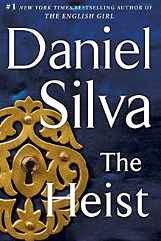
And in the No. 1 spot? None other than art restorer and accomplished Israeli spy Gabriel Allon, who's the star of this book. In it - the 14th in the series - his beautiful (and younger) wife, Chiara, is pregnant with twins; they've been living in Vienna, where Gabriel is helping restore a major work of art. When a friend discovers the torture and murder of a former British diplomat who apparently has turned to trafficking stolen art, Gabriel begins to investigate - learning that the works of art may be a cover for a Syrian dictator to hide scandalous amounts of money. The chase, as usual, takes Gabriel to several countries where he dons different disguises as he and his team put together an involved operation to bring the dictator to his knees and, hopefully, locate the stolen art (in particular, a Caravaggio that's been missing for decades).
Many characters from previous books return in this one, and perhaps a little too much space is given up to explanations of who they are for the benefit, I suppose, of making sure new readers know the background rather than simply trying to fill up pages. Also, the ending is predictable and a bit abrupt - reasons that prompted me to give this one 4 stars rather than 5.
But in the end, it's a great adventure and a pleasure to read. I always enjoy the historical information that's sprinkled liberally throughout (even if it's not always factual). I honestly can't say this book is the best of the bunch, but it sure held my attention throughout.
The Heist by Daniel Silva (Harper, July 2014); 497 pp.
Addendum posted Aug. 25, 2019: A friend on Goodreads.com asked for more possibilities - I'd said I could come up with another 10 at a minute's notice - so I did just that. This list is in no particular order, but here you go:
FBI agent A.X.L. Pendergast (Douglas Preston and Lincoln Child)
U.S. Marshal Lucas Davenport (John Sandford)
Detective Peter Decker (Faye Kellerman)
Detective Amos Decker (David Baldacci)
Jesse Stone (former Robert B. Parker, now Reed Farrel Coleman)
Forensic Detective Lincoln Rhyme (Jeffery Deaver)
Game Warden Mike Bowditch (Paul Doiron)
Detective Alex Cross (James Patterson)
Attorney Dismas Hardy (John Lescroat)
Private Investigator Hieronymous "Harry" Bosch (Michael Connelly)
FBI Brit Nicholas Drummond (Catherine Coulter)
Debut book looks promising: Private eye Colter Shaw (new from Jeffery Deaver)
5 stars out of 5

If for no other reason than writing that is eloquent, even exquisite, this book deserves to be read. It is, IMHO, story-telling at its absolute best (and if I could give it 10 stars, I would). Basically, it's a tale of lifelong friends, Jonah Kirk and Malcolm Pomeranz, that takes place in New York City and begins in the 1950s and ends when Jonah, who relates most of the story as a recollection of life-altering events, is 57.
Actually, it begins with The Neighborhood, a short story and prequel to this book (https://www.goodreads.com/review/show/989028284). It was very good - I gave it 5 stars as well - so it's definitely worth reading. But although it provides a foundation for this book - and I recommend reading it if you can get your hands on a copy - I don't think it's absolutely necessary to read it before tackling The City.
Both Jonah and Malcolm are musical prodigies - Jonah a piano man and Malcolm a saxophonist. Jonah is black and Malcolm is white, and both come from interesting, if different families. Jonah's mostly-absent father has a history of breaking his mother's heart; Malcolm's parents, who live in the same house, are equally absent from each other, forcing Malcolm and his older sister, Amalia, to do all the household chores. When the story begins, Amalia has earned a scholarship to a prestigious university and soon will be leaving Malcolm, who is somewhere around 12 years old, behind.
A few years earlier, Jonah a mysterious woman he calls Pearl - a woman who changes his life forever by somehow arranging for a piano to appear in the community center Jonah frequents; that leads to piano lessons and a path toward becoming a professional musician like Jonah's mother - a lunch counter waitress by day and singer by night.
As Jonah relates the events of his past, readers learn of the endearing and contentious relationships with his mother, his grandfather, his errant father, another mysterious woman named Fiona Cassidy who appears to Jonah in a dream (dead, I might add) and a couple of other notable characters. Jonah's tale is one of love, intrigue and yes, suspense - but don't expect in-your-face, edge-of-your-seat horror. More than anything else, this is a touching story about love, courage, the end of innocence in the whole of a city that's bigger than the sum of its parts. Or, to quote a line from the book, "Time teaches us that the musical score of life oscillates between that of 'Psycho' and 'The Sound of Music'..."
The City: A Novel by Dean Koontz (Bantam, July 2014); 418 pp.
4 stars out of 5
Dirk Pitt, Clive Cussler's legendary hero who's now heading up the National Underwater and Marine Agency, doesn't play much of a role in this one, but there's plenty of action nonetheless. In fact, it's a little too much for me; NUMA agents Kurt Austin and fellow agent and friend Joe Zavala are about as close to super-heroes as you can get. No capes, perhaps, but plenty of other gadgets and gizmos courtesy of the U.S. government (chameleon suits? Who knew??) to satisfy all the techies out there.
In the beginning, Austin is injured while trying to rescue folks (one a former love) from a yacht that's about to sink. But his injuries come with memory malfunctions, and he isn't sure exactly what he saw. Determined to get to the truth - and prove that his long-ago love really isn't dead - he teams up with his pal Zavala to investigate (with Pitt's permission). All this leads to the discovery of a ship that was thought to be lost nearly a century ago and the possible downfall of the United States itself that brings computer hacking to a whole new level.
Some of Cussler's work of late has been less than satisfying, but this one - co-written by Graham Brown - is, with the exception of the aforementioned almost unbelievable super-hero antics, perhaps - very well done. The story is a bit complex, but the authors do a great job of sorting it all out so it makes sense in the end.
Ghost Ship (The NUMA Files) by Clive Cussler (Putnam Adult, May 2014); 440 pp.
5 stars out of 5
After I read Blood Sacrifice, which is No. 5 in the series featuring North Florida prison chaplain and former cop John Jordan, I loved it so much I knew I wouldn't stop until I'd read others - even if it meant reading them out of order. If my experience with that one taught me nothing else (except what a terrific writer Michael Lister is), it's that these books can stand alone (read my review of that one at https://www.goodreads.com/review/show/880641103).
 Since I'm always looking for bargains, I didn't rush out to buy another one, though, and as it turns out I'm glad. Not long after I finished Blood Sacrifice, I was notified of a credit to my Amazon account as a result of a class-action settlement regarding Kindle book pricing, and I was able to snag two more of the series including this one. It's No. 4, and I had zero problem with reading it even though I'd already read the one that follows.
And happily, it didn't disappoint. This one takes place in the Potter Correctional Institution's Protective Management Unit, which houses inmates who, for various reasons, aren't likely to live long and prosper in the "regular" part of the prison. Jordan is here because he received a note claiming that a murder will take place during the Catholic Mass. Just after the elderly priest serves communion - the body and blood - Jordan sees an inmate enter a cell alone, and shortly thereafter blood begins to spread out from under the locked door.
Sure enough, the inmate is dead - his throat cut quite recently - but no one else entered or exited the cell. It turns out that the inmate, a very talented artist, may have been an innocent man - and a man who, for a different reason, was to be released in a few days. One question, of course, is why he was killed, but an even more puzzling one is how. It seems impossible that anyone could have gone in or out without being seen.
As the story moves along, still more crimes turn up, and the number of suspects grows as well. On the list of possibilities are a couple of unit officers, the victim's sister, a few inmates (one of whom is the victim's lover) and even the elderly priest. Meantime, Jordan is trying to get his jumbled personal life in order, having recently entered into a tentative reconciliation with his estranged wife Susan.
Interspersed is a bit of humor - in his car being followed by two suspicious characters, for instance, Jordan muses that if they catch him, he'll have to pull out the only weapon he has at hand - a Barry Manilow CD.
Lister has another winner on his hands, and now I can't wait to start the other one I have (Rivers to Blood, which is book No. 6.
The Body and the Blood by Michael Lister (Pulpwood Press, December 2011); 336 pp.

