She's earned chops at other forms of writing, but this is the author's first at-bat with a novel. And by golly, she's hit a home run with the bases loaded. Put another way, WOW!
The book begins in England in 1995 with a peek into the life of 15-year-old Amy Stevenson - a young girl with a few good friends, a mother and stepfather she adores (well, most of the time - she's 15, after all), a sweet boyfriend - and a big secret. Fast-forward 15 years and we see Amy again; this time, we learn she's been in a coma for all those years, the victim of a vicious assault. Her secret , it seems, still is safe.
Now, though, that could change. Amy is unable to communicate, but freelance reporter Alex Dale is chomping at the bit to do a human-interest story on comatose patients and zeroes in on Amy. Alex, though, comes with secrets of her own; she's got an ex-husband she still loves (a cop), a former but once-promising career as a journalist and an addiction she just can't sweep under the rug. But as she begins to dig into what really happened to Amy - police investigated the case back then but found no conclusive evidence - Alex becomes more determined each day to get to the truth and, at least in some measure, bring closure both to herself and to Amy.
Chapters of the book, which for the record I received for review from the publisher via Netgalley, shift from present to past - a technique that works perfectly here for a couple of reasons. First, each chapter is subtitled with the year and name of the character whose perspective is showcased; that alone alleviates the confusion I've experienced in other books over who's who and what's what. More importantly, each chapter reveals just enough information to compel me to keep going. In fact, I read this book over two days, setting it down with great reluctance and telling my very hungry husband, "Just one more chapter, honey" so often that he finally rolled his eyes, picked up the phone and ordered a pizza.
There's a lot more I'd love to say, but because the layers of truth are peeled back slowly in successive chapters (very skillfully, I might add), doing so would spoil things for other readers. But one thing I'll shout from the rooftops: This is one of the best books I've read in a while. Highly recommended!
Try Not to Breathe by Holly Seddon (Ballantine Books, February 2016); 368 pp.
4 stars out of 5
 Reading works by writers who are picking up the character bandwagon that halted when the original authors died (Robert B. Parker's Spenser and Jesse Stone and Ian Fleming's James Bond come to mind immediately) has always been a bit of a bittersweet experience for me. In those instances, it's almost impossible not to compare the new with the old (although in some respects, that's as it should be; after all, they're writing about the same characters and, intentionally, in a similar style).
This one, to which I was given access by the publisher through Netgalley, continues the work of the late Carolyn Weston, whose characters Sgt. Al Krug and his partner Casey Kellog became the basis for the TV show The Streets of San Francisco. To that end, I'm at a disadvantage; I've never read any of Weston's books. I was, however, a big fan of the TV show - which aired from 1972 to 1977 - and in particular of a very young and very talented Michael Douglas. So whether the author managed to capture the essence of Weston's books I can't say, but I do think it's reminiscent of the show and is an excellent police procedural in its own right.
It begins as Krug and Kellog - the latter new to the San Francisco Homicide team and mismatched with his partner in age, experience and attitude toward the job - investigate a series of murders by the "Landmark Strangler" (so named because the victims are found near well-known city landmarks). But when they take a look at the most recent, the fourth in just four months, something just doesn't seem right even though the body was found near the Presidio. Then, a nosy reporter with her eye on a Pulitzer questions the relationship of much-earlier murders to those of the strangler, adding a potentially new dimension to the investigation. When more clues lead to the office of a prominent politician, though, things really start to heat up: Krug and Kellog not only are under the gun to solve the cases, but under orders to avoid ruffling feathers of the powers that be.
The story held my interest from beginning to end, and for sure I'll be in line when and if the next edition is published. Meanwhile, I plan to check out some of the other books the accomplished Ms. Burcell has written!
The Last Good Place by Robin Burcell (Brash Books, November 2015); 289 pp.
4 stars out of 5
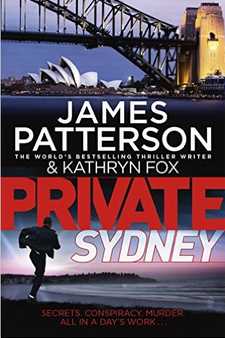
 This is, I believe, the 10th book in the author James Patterson's Private series, and while it's nowhere near my favorite of the bunch, it helps cement my opinion that this is one of the best of all the ongoing series with which he's involved. For obvious reasons, I suppose, the co-author on this one is Kathryn Fox, who lives in Sydney, Australia, and is an accomplished author in her own right. If reports that co-written books are written by sending chapters back and forth between Patterson and the co-author du jour are correct, if nothing else it would account for inclusion of Australian British spellings liberally sprinkled throughout (fittingly, given the location).
If you're expecting much from elite Los Angeles-based detective agency founder Jack Morgan, though, you'll be disappointed; except for a couple of phone calls, he's pretty much nonexistent. This time, the focus is on the Sydney operation and its top dog, Craig Gisto, and his team. From the start, there are two storylines; one involves the sudden and total disappearance of high-profile Australian research company CEO Eric Moss. The request for help came via the CEO's daughter, who happens to be a close friend of Jack Morgan (one phone call down).
The other case came about when Gisto meets a couple asking that the agency do a background check on a potential surrogate mother who has agreed to bear a child for them. To be sure, it's not the sort of case Private Sydney would consider, but for purely personal reasons, Gisto agrees to take it on over the objections of his office mates. Early on, however, it turns into a case murder and kidnapping of an infant - vindicating Gisto for his decision but putting him on the wrong side of Australian law, which prohibits the sale of surrogate services.
The chase to find the missing CEO commands the lion's share of attention throughout the book (in fact, by the end it almost seemed to me as if the Babygate scheme, while interesting and well written, was concocted more to fill up pages than anything else). Efforts to conduct any investigation of the CEO's disappearance from the company headquarters quickly run into stonewalling by the new head honcho - who clearly has no love for the missing guy - and further efforts to discern his whereabouts lead only to dead ends (both figuratively and literally). Clearly, there's more to this story than meets the eye, and sticking to their investigative guns could destroy the stellar reputation of Private Sydney and jeopardize the future of the agency.
Private Sydney by James Patterson and Kathryn Fox (Cornerstone, August 2015); 400 pp.
4 stars out of 5
 X marks the spot, I must confess, where I became a teeny bit happy that there are only two letters left in the alphabet. Don't get me wrong, though; this is nowhere near a bad book - nor is any of the others in this series (I've devoured every single one and by now, P.I. Kinsey Millhone feels like a good friend). But early on in this one, precious little action and endless descriptions of who had what for dinner, what clothes who wore but shouldn't have and how many complimentary envelopes were in a hotel desk drawer rendered me almost as bored as Kinsey was on one of her stakeouts (or so she said).
The book begins as Kinsey takes on a client who's looking to be reunited with a son she gave up for adoption years ago. At the same time, Kinsey's been asked by the widow of a P.I. who was killed off in an earlier book (nope, won't tell), to help sort through her late husband's boxes of papers because an IRS guy is threatening an audit. When it turns out the client may not be totally on the up-an-up - and the late husband's papers turn into clues related to an old crime - Kinsey is off and running to find answers.
Lovable characters from past books get involved, of course - like octogenarian landlord Henry, his even older brother William and Henry's cantankerous cat Ed, who strayed into Henry's life in W is for Wasted. Adding to their woes is that their little part of California has been in the midst of a longstanding drought, and Henry is consumed with finding new ways to lower his water bill. Ever the consummate gentleman, he's also taken a shine to the elderly couple who moved in next door, readily offering assistance to the wife as she cares for her invalid husband.
The plot itself is both intricate and intriguing, and on the plus side, once I reached the 60% mark or so, the action started to heat up on all fronts and the ho-hum parts dwindled to a minimum. The primary whodunit was all but confirmed (the only thing remaining was the thrill of the chase, with Kinsey in the lead). The subplots began to take on new relevance, and from that point on I didn't put the book down till I reached the end.
X (A Kinsey Millhone Novel) by Sue Grafton (Marian Wood Books/Putnam, August 2015); 416 pp.
4 stars out of 5
 Leah Mills was involved in something awful 14 years ago when she was a teenager, and it's dogged her mind ever since. Although she fled from the town in which it happened (moving to London, where she works in a library and lives almost as a recluse), the thought that her past will catch up with her is always in her mind. Almost as a lark, she visits an online dating site and has a virtual meet-up with site moderator Julian. Second-guessing herself every step of the way as she apparently has done since early childhood - she could be the poster child for insecurity - she begins to think a real relationship with Julian may be possible.
But then, she gets a nasty surprise: Someone, it seems, has discovered her true identity which, on the anniversary of that horrible event, threatens to disrupt her already miserable life. She tries to ignore the message, but as usual, her self-doubt wins out, prompting her to question even more than usual the words and actions of her co-workers (as for friends, fuhgettaboutit; she has none). As it becomes clear that her tormentor isn't going to leave her alone, her self-esteem nosedives to new lows. Meanwhile, neither her Mum, who still lives in the family home near London, or the psychologist she sees every once in a while, is able to help - mostly because she refuses to open up to either of them - but she manages to find a bit of solace through interaction with Julian and a kindly gentleman who frequents the library but in whom she has no romantic interest.
Chapters shuffle back and forth from the present to Leah's school years, a technique of which I'm usually not a fan. But the author uses it to good advantage, here, with each switch adding just enough background and clues to make me reluctant to put the book down till the end, when everything comes together and the realities of past and present are revealed. Early on, I reached my own conclusions - correctly, as it turns out - but it really didn't matter; the devil is in the details, after all.
One thing I never did figure out, though: How is it possible to cradle a mug of hot tea to keep your hands warm while simultaneously surfing through photos on a laptop? Multi-tasker that I am, that's a secret I'd really love to know!
For the record, I received a copy of this book for review at no cost from the publisher through Netgalley.com.
The Girl With No Past by Kathryn Croft (Bookouture, October 2015); 261 pp.
5 stars out of 5
 In many ways - none of which I can specify without spoiling it for others - this book was disturbing to me (not that there's anything wrong with that). Put another way, it's twisted just enough that I enjoyed it thoroughly.
For those who don't already know, this one "stars" a psychologist, but it's not the author's popular Dr. Alex Delaware (although he does get a few mentions here). Instead, this stand-alone novel is about Dr. Grace Blades, a child prodigy who watched her parents die in a murder-suicide when she was just 5 years old. That, and living through a foster care system notorious for undesirables, left her with emotional scars that never healed even after she finally found loving adoptive parents. Thanks to her intelligence, drive and well-honed survival instincts, she accomplishes her goal of becoming a much sought-after psychologist capable of treating the most troubled of patients with success.
But then, she opens her office door to a man with whom she quite recently had a brief encounter in a parking deck. He really needs her help, but Grace decides that because of that encounter, she must say no and turns him away. Shortly thereafter, the man is found murdered. Curious and feeling a little guilty for not agreeing to take him on as a patient (inasmuch as she's able to have feelings for anyone or anything), she temporarily shuts down her office and sets out on an investigation of her own.
Once she ferrets out the almost-patient's real name, she realizes there's more to their connection than the parking deck meetup - a dark connection that requires her to bring to the forefront the childhood experiences she's compartmentalized in her mind over the years. Her sleuthing does seem to yield results faster and with less to go on than seems realistic for the average human, but after all, she's been way ahead of the intelligence game since she was a toddler.
As I said at the beginning, I really enjoyed this book. But I will add this: If you're expecting to "connect" with any of the seriously flawed characters here, it's likely you'll be disappointed. Not a single one - not even Grace herself - exhibits anything close to a warm and fuzzy personality. But IMHO, for the purpose of this story, that's exactly as it should be.
The Murderer's Daughter by Jonathan Kellerman (Ballantine Books, August 2015); 384 pp.
4 stars out of 5
 As a long-time writer of nonfiction (that's right, all you storytellers out there, you'll never have to worry about competition from me), I've thought about publishing an ebook a few times. What kept me from actually trying to do that, though, is one of the first requirements mentioned in this book: You have to know enough about something - from personal experience - before you can pass it on to others. The author does, however, point out that the knowledge doesn't have to be extensive enough to fill hundreds of pages; find a particular niche, narrow your topic to fit and stick to it.
He does exactly that in this short (71 pages) ebook, explaining what you need to do - assuming, unlike me, you really do have information to share - from concept to outline to first draft to publication. And while he says it's possible to get from start to finish in 21 days, he emphasizes that speed is secondary to quality (hmmmm, I know a few big-time fiction writers who would do well to remember that one).
Still other helpful points that yanked my "you betcha" chain include reading your finished work aloud (to make sure you didn't inadvertently leave out words or make other grammatical errors) and get yourself a proofreader (to which I'd add make that two or three). This book won't do the job for you, of course, but it does provide a solid framework for getting you on the right track.
How to Write a Nonfiction eBook in 21 Days - That Readers LOVE! by Steve Scott (Amazon Digital Services Inc., January 2014); 71 pp.
 She's earned chops at other forms of writing, but this is the author's first at-bat with a novel. And by golly, she's hit a home run with the bases loaded. Put another way, WOW!