5 stars out of 5

Oh my. Good thing I'm a fast reader. From the moment I booted up my Kindle Fire and opened this book, I didn't want to put it down. As it was, it took two days - although that's not bad considering all the other "stuff" I had to do in between. I'll give a special shout-out to my ever-lovin' hubby, who didn't blink an eye when I told him dinner would be a little later than usual tonight because I was too close to the end to stop).
Still another thank you goes to the author and publisher, via NetGalley, for providing me with a copy in exchange for an honest review. To that end, will "Wow!" suffice?
For everyone else, a bit of a plot description is in order. This is the third in the series featuring Detective Erika Foster (preceded by The Girl in the Ice and Night Stalker. Here, she's serving at the Bromley Police Station in London, where she was transferred three months earlier. She didn't arrive without baggage; her police career is dotted with successes and failures, with one of the latter involving the death of her beloved husband, for which she's blamed herself ever since. She's an immigrant from Slovakia, and she's had to fight her own feelings of inadequacy that have been augmented along the way by some of her police colleagues.
Already, though, she's bored with her assignment that's limited to investigating organized crime cases. But as luck would have it, when she orders a search of an old quarry after getting a tip that a big stash of narcotics is at the bottom, something else turns up: The remains of a young girl. Almost immediately, the child is identified as Jessica Collins, who as a seven-year-old disappeared from her home 26 years ago. The case made big-time headlines back then, but no perpetrator was ever found.
It's an uphill battle to get assigned to the cold case, but Erika is determined to get it and keeps dogging her superiors until they cave in - albeit with orders to get it wrapped up as quickly as possible or else. Erika manages to get the go-ahead to beef up her staff and turns to a couple of former co-workers to help (readers of those first two books will recognize them). But at the git-go, the case looks hopeless; the primary suspect who was cleared of the abduction all those years ago sued the city and won, making it nearly impossible for the officers to approach him again. The missing child's parents have split up, leaving the family in shambles. The original case detective, Amanda Baker, became a pariah, left the force and turned into an alcoholic hermit. And, when another suspect is identified, it turns out he died many years ago and is, obviously, unavailable for comment. As if that weren't enough, roadblocks keep popping up to impede the investigation that may be coming from a source closer to home.
Getting to the truth turns out to be a series of wrong and right turns, stops and starts - and a couple of big surprises. Only two things, in fact, could I count on, the first of which is that the next chapter would be even better than the one I was reading. The second? Any time two or more characters got together, one of them was sure to ask, "Would you like some tea?" Gotta love those Brits!
Dark Water by Robert Bryndza (Bookouture, October 2016); 368 pp.
 4 stars out of 5
There's a bit of a different feel to this one, the 21st, I believe, in the author's popular Jack Reacher series. That's probably because it takes place back in 1996, when Reacher is still in the army. He's got pretty much the same swagger, mental and physical capabilities, but he seems a little less, well, for want of a better word, exciting. Put another way, except for the obvious physical size differential, at times I actually could envision Tom Cruise in the movie role this time around.
The story, though, is no less interesting - even if it does happen when computers aren't yet the norm and the Internet is not much more than a gleam in Al Gore's eye. It begins as Reacher is getting another medal - one that will be kept secret and in that sense is rather meaningless. After the ceremony, he's surprised at being ordered immediately to "night school," which turns out to be something else entirely - the start of a clandestine operation. In the classroom are two other men, one from the FBI and the other from the CIA. Then, they learn the reason they're there: A CIA spy who has infiltrated a Middle-Eastern sleeper cell in Hamburg, Germany, has passed on a message that "The American wants a hundred million dollars."
That's an almost unheard-of sum of money, setting off alarm bells as to what's being bought and sold and by whom. To help, Reacher reels in an extremely competent soldier and friend, Sgt. Frances Neagley. From the start, their investigation must be conducted in utmost secrecy - with less than a handful of individuals aware of what they're doing (one of whom is the President of the United States). Other characters enter the mix as needed, some of whom have motives that aren't exactly in line with the goals of Reacher and his team.
Along with a plain old good story, Reacher shows flashes of the character he will become in later books: A man who loves his country enough to die for it, but who at the same time is willing to deviate from standard practices when getting the job done requires thinking outside government-issue boxes.
As always, it took me a few chapters to get used to the short, almost jabbing sentences (or, more accurately, sentence fragments - always like fingernails on a blackboard to a grammar freak like me). But also as always, the story grabbed ahold of all my senses and I quickly got into the rapid flow of things. All in all, another winner for the author - although I do hope he brings Reacher back to the here and now in the next one. Guess I just like my guys with a little more maturity under their shoulder holsters.
Night School by Lee Child (Delacorte Press, November 2016); 385 pp.
5 stars out of 5
Consider me mind-boggled!

But it's not for the first time. That happened somewhere around 1970, when I tried to wrap my head around Alvin Toffler's Future Shock (followed by The Third Wave and Power Shift. Then came books by John Naisbitt, such as Megatrends 2000, and Faith Popcorn's Clicking: 17 Trends That Drive Your Business And Your Life. Yes, folks, I eat this stuff up. And now, thanks to an advance copy in exchange for an honest review, comes this one - and it's made no less of an impression.
The author has developed a six-part process for forecasting - a way of evaluating new ideas being developed on the "fringe" (a.k.a. around the edges of society) that stand to affect us. Futurists, she says, listen to and interpret the signals that are "talking," looking for early patterns, or pre-trends. "Trends help us to understand change, which is an essential part of every organization's mandate," she writes. "Too often, leaders ignore the signals, wait too long to take action, or plan for only one scenario."
Descriptors like "probable," "plausible" and "possible" are used to generate concrete ideas about what's over the horizon. "We must think of trends as signposts that can illuminate the conditions we will likely encounter at some point in the future, even if that future is a century away," the author explains. "Organizations must track them if they are to create their preferred futures...seeing trends is a matter of looking for emerging changes at the fringe, within organizations, and in our societies."
In a nutshell, if it's possible to put it there, the book is about the importance of not being surprised by the future, offering a method for creating a path that leads to sustained success. Unlike some of the books mentioned above, it's not a list of what we can expect to happen in the next 10, 20 or 50 years; rather, it's a way to help ensure that organizations will be going strong throughout all those years to come.
Along the way, the author explains finer points such as the difference between something that's "trendy" and a "trend." No doubt it's a silly analogy, but if I interpret it anywhere near correctly, an Erector set is (or was) trendy, but the fact that children love to tear things down and build them up again is a trend that's likely to continue indefinitely. Harness your company's future to the first, and you may be out of business the minute a newer kid hits the building block; on the second, and you're likely to stay ahead of the curve.
Roadblocks to identifying the signals are discussed as well, such as the "duality dilemma" between left- and right-brain thinking (put another way, creativity vs. logic) and the need to look at things from both sides now. This I understand; I identify far more closely with the logic side, which most likely explains why I've enjoyed relative success as a journalist (just the facts, ma'am) but couldn't write a novel if my life depended on it. It's also, I'm thinking, one of the reasons I enjoyed this book so much; everything is laid out in an orderly, easy-to-understand manner.
That includes, for the record, a glossary of concepts and terms and a chapter-by-chapter list of footnoted references at the end. Highly recommended for anyone interested in expanding leadership skills (or like me, simply interested in the topic).
The Signals Are Talking: Why Today's Fringe Is Tomorrow's Mainstream by Amy Webb (Public Affairs, December 2016); 335 pp.
4 stars out of 5

Let's set the record straight right away: Two things are guaranteed to spike my personal barf-o-meter. First is extreme heat and humidity; when the temperature turns upwards of 75 degrees Fahrenheit, I turn into a shrew. Second is dressing animals in human-like clothing (well, make that any kind of clothing). Never once has a bonnet or ruffled collar come anywhere near any of my furry darlings.
So given that this book is set in New Orleans, where 95 degrees signals a cool-down, and the main character is the owner of Furry Godmother - a shop that sells glitzy animal costumes and high-end home-baked treats - what on earth would tempt me to read it? Big hint: The word "cat" in the title. Puppies and other baby animals are cute, I admit, but if you want to melt my heart, put a kitty of any size in my arms. Still another reason for my requesting this book is that every once in a while I love to "cozy" up to a mystery book that isn't full of murder, mayhem and gore. And this, the first of a series, filled the bill purrfectly.
For that, a big thank you to the author and publisher, via NetGalley, for allowing me to read an advance copy in exchange for an honest review.
The heroine is Lacy Marie Crocker, a native of the city, who's returned home after a disastrous romantic hook-up. She's got a cute shop in the ritzy Garden District, but she's struggling. She doesn't want to take money from her well-heeled parents and banks won't give her a loan, but for the present, she's making do with an investment from a local jewelry store owner.
Out of nowhere, disaster strikes; first, she has a run-in at the store with a very unpleasant character. Shortly thereafter, the glitter gun she was using to bedeck an order of tutus for Shih Tzus is the weapon of choice in the murder of that same character. Well gosh - guess who becomes the prime suspect?
Along with that comes a string of jewel thefts from local shops (for gosh sakes, how many jewelry stores could there be in one district)? And all that brings in the requisite potential love interest, Detective Jack Oliver. As expected in a book of this type, they alternate between serious attraction and silly bickering - and yes, there's the threat of another romantic interest in the form of the hunky brother-in-law of Lacy's best friend.
Despite Jack's constant badgering to stay out of his investigation, Lacy doesn't comply (a woman's got to do what a woman's got to do to clear her name, right)? Besides, she's got a business to run, orders to complete and an independent itch to scratch. Of course, that leads to all kinds of potential and real danger and intensifies the bickering with Jack (no doubt I'm in the minority, but the human cat-and-mouse games that seem to go with the cozy mystery genre are far more annoying to me than entertaining). But all's well that ends well - one of the pleasant aspects of cozies - so overall it's a cute, enjoyable and very well-written book.
Also enjoyable is that each chapter begins with a "Furry Godmother's Secret; my favorite is the "Secret to a happy life: Keep your friends close. Sometimes they bring wine." At the end are recipes for making some of the pet treats mentioned in the story (reminiscent of Murder at the Mansion by Alison Golden and Jamie Vougeot, another enjoyable cozy mystery.
Cat Got Your Diamonds: A Kitty Couture Mystery by Julie Chase (Crooked Lane Books, November 2016); 304 pp.
5 stars out of 5
 It doesn't matter which of the author's series it is - the one with "Lincoln Lawyer" Mickey Haller or this one with private investigator Hieronymous "Harry" Bosch - when the latest edition is released, I want it - and I want it now. This one is no exception, and my 5-star rating says Mr. Connelly remains solidly on his A-game.
Of course, one might argue that with one, you get the other; in an earlier book, they - and readers - learned they're half-brothers. Ever since then, one has made at least a cameo appearance in the other's books, as is the case here. But there's no question that it's Bosch at center stage - and working two parallel story lines, no less.
The first story begins as Bosch, a former Los Angeles Police Department 30-year police detective turned PI who now works part-time (think: free) for the budget-challenged San Fernando Police Department, is asked by a former LAPD supervisor that one of the supervisor's clients wants a meeting with Bosch. The elderly client has written Bosch a check for $10,000 for the meeting - regardless of whether Bosch agrees to take on the job. As it turns out, the 85-year-old Whitney Vance is filthy rich (Howard Hughes is his godfather, for gosh sake), not in the best of health and, as far as the rest of the world knows, will pass on to the great beyond with no heirs. That last point, however, is in question; it seems a long-ago encounter with an older Mexican girl may have resulted in a child, and Vance wants Bosch to find out for sure before the old guy, well, croaks.
In Bosch's other life as a part-time detective, a serial rapist dubbed the Screen Cutter is on the loose and racking up victims. Never one to pass up a challenge, Bosch throws himself smack in the middle of that investigation, hoping to find the perp before he strikes again and - if profilers got it right - escalates to murder. Meantime, the premise is that no female in the San Fernando area is safe, perhaps including Bosch's own daughter.
Needless to say, with two cases moving along at the near-speed of light, the action doesn't let up much. The often irascible Bosch has the expected run-ins with other law enforcement characters who don't quite see things his way, and his part-time job is threatened when he goes against orders to use SFPD resources on the case he's working on as a PI. But never fear. Bosch will prevail - with more than a little help from his half-brother. And at the end, readers get a glimpse into what the future holds for Bosch (well, at least the immediate future; with a guy like him, that's about as far ahead as anyone - including Bosch himself - can predict. And that's just fine with me.
The Wrong Side of Goodbye by Michael Connelly (Little, Brown and Co., November 2016); 401 pp.
 4 stars out of 5
Generally speaking, I'm a start-at-the-beginning kind of reader when it comes to books in a series. So when I was offered a chance to read an advance copy of this one (the fourth in a series featuring security specialist and private investigator Jamie Sinclair) in exchange for an honest review, I hesitated - but only for a moment. Simply put, the description just sounded too intriguing to pass it up.
And happy to say, I made a good decision. I still stand by my general advice that it's better to get in on any series from the start, but I certainly didn't feel left out with this one, which stands on its own just fine.
Jamie is an interesting character in and of herself; the daughter of a former military bigwig turned powerful state senator, she's got an ex-husband and in this book, two hunky guys falling all over her (reminiscent of Stephanie Plum, the Janet Evanovich character who, even after all these years, is torn between two lovers, as the old song goes). Truth is, that waffling back and forth - particularly since it's coming from an otherwise strong, extremely independent woman - never fails to get on my nerves in that series, and it does here as well. But a fast-moving plot loaded with knock-down, drag-out action made up for it by grabbing and holding my attention throughout.
At the beginning, Jamie seems to have settled on one of the hunks - military police officer Adam Barrett. He's stationed in Beauville, Mississippi, where Ray Walther, who took a chance by hiring Jamie at his PI firm years ago, is located. Now, she's got her own investigative firm near Washington, D.C., but she's flying down to the coast in hopes of hooking up with Adam as well as seeing her mentor (and her close friend, Ray's pregnant wife, Corinne) again.
To say things don't go as planned would be an understatement. At the git-go, as Jamie and Adam try to get away from a mandatory military party on a riverboat, a dirty bomb explodes. Because they had fled the boring party and headed for privacy on another deck, they escaped the brunt of the blast in which several were killed. But then, Jamie catches a glimpse of the bomber and recognizes him. Her desire to get to the bottom of things - and Adam's military responsibilities to that same end - put an instant kabosh on romance and set the pair on an investigation fraught with danger.
Enter Marc - the other hunka-hunka who also is part of the investigation, and the romantic tension begins to build. As for the case, the more Jamie learns, the more she suspects some kind of connection between the bomb and her former mentor, his new partner and even his wife. Are their lives in danger? Or could any or all of them (gasp!) be involved in a more sinister way? The chase is on complete with wrong turns and dead ends, and Jamie, Adam and Marc find themselves fighting not only for the lives of her friends, but their own as well.
Conclusion? Very enjoyable, and I've already put the next installment of this series on my to-watch-for list.
The Kill Sign: A Jamie Sinclair Novel by Nicole Christoff (Alibi, December 2016).
3 stars out of 5

The checklist I use when I'm composing a book review includes how reluctant I am to shut down my Kindle when other duties call - and on the other end, how eager I am to start reading it again. On that score, this one falls a bit short. It's certainly not a bad story, but I just couldn't work up much enthusiasm for it.
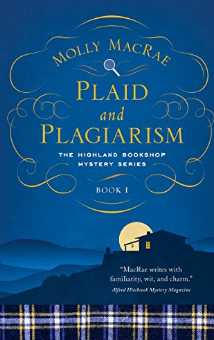
Honestly, I'm not sure why. Admittedly I'll never be a huge fan of "cozy" mysteries, but I do enjoy them now and again. I love books and bookstores (one of my favorite series is Lawrence Block's The Burgler Who, with Barnegat Books owner Bernie Rhodenbarr), and this book focuses on the four new owners of Yon Bonnie Books. The setting is the smallish Scotland community of Inversgail, a country of interest to me thanks to a wonderful daughter-in-law who was born and raised in the United Kingdom. There are even wee touches of humor here and there and it's the first of a series, all coming together to make the book a seemingly ideal choice for me - hence my quick acceptance of an advance copy (via NetGalley) in exchange for an honest review.
Janet Marsh is one of the four bookstore owners who has returned from Illinois to Scotland, where she lived with her now ex-husband (a.k.a. The Rat) until about five years ago. She starts off in something of a confused state when she learns her former house won't be ready to move into as planned. Then, she learns it'll be even longer because it's been vandalized for the second time. As if that weren't enough, there's still another delay when the body of local advice columnist (a.k.a. "Agony Aunt") Una Graham (a.k.a. "Ug") is found in the shed behind Janet's house - the shed The Rat built that Janet always hated anyway.
The other owners include Janet's 38-year-old daughter Tallie (short for Natalie), a lawyer back in the states, Janet's old friend Christine Robertson and journalist Summer Jacobs, Tallie's former college roommate. They begin the transition to full-time owners with the help of former owners Kenneth and Pamela Lawrie as well as pursue plans to create a tea room and small bed-and-breakfast in the space next to the bookstore. Janet learns that the neighbor next door to her not-yet-ready-to-move-in house is an illusive but well-known author, and the bookstore itself becomes a haven for a mysterious old woman who sits in the shop for hours tending to her knitting and not once uttering a word. Meanwhile, there's an upcoming annual Inversgail Literature Festival, and two of the bookstore owners take on even more work by agreeing to serve as judges for what seemed to me to be an astounding number of entries given the size of the community.
Whew! Wound in and around all this is the four women's unflagging determination to find the murderer; in between all their other activities they keep notes on their investigation in the Cloud and bug the heck out of the local police detective (himself a curious and not particularly likable person, BTW).
All in good fun, right? It should be, but to me, not so much. There are a few too many characters for me to keep straight, a few too many Gaelic words and phrases that kept me a bit confused, and the banter among the four store owners never really clicked in my [non-Scottish] brain. By about the three-quarter mark, I really didn't care who the culprit was (but that said, yes, it was a surprise, and that's a plus). All things considered, I'm sure this book will have appeal to many readers, and there's plenty of potential for the series as a whole. But wheesht - it didn't quite do it for me.
Plaid and Plagiarism: The Highland Bookshop Mystery Series Book 1 by Molly MacRae (Pegasus Books, December 2016); 336 pp.