4 stars out of 5
 I'm a fan of this series and of Timber Creek Deputy Mattie Cobb and her K-9 partner Robo. While I enjoyed this one, the fifth, I have to say not quite as much as the predecessors. That is, I think, because of heavier focus on Mattie's romantic life and all the baggage she brings into her budding relationship with local veterinarian Cole Walker - I prefer reading about her relationship with Robo. As for Cole, I do have to wonder when he actually practices his trade given that he's always helping Mattie and her department, taking care of his two daughters and/or trying to cope with his ex-wife, Olivia, who suffers from serious depression.
All that aside, though, the actual story is both intriguing and fast-paced. It begins as Mattie is called to the scene of a burning van. One man has been shot dead and another has been taken to the hospital. The dead man was well known - married to the daughter of an elderly landowner couple - but he was well liked and a motive isn't easy to nail down, at least at the outset. As the investigation progresses - helped along by Robo's considerable tracking skills, of course - a few suspects emerge. But just as one rises to the top, he, too, turns up dead. Clearly, these aren't your garden-variety killings; in fact, they have more to do with the vast forests that surround Colorado's Timber Creek region. And Mattie, Cole and Robo soon learn that there's an even bigger danger than they thought in them thar woods; will they all manage to escape unscathed?
Well, of course I'm not going to answer that - go read it for yourself. The ending also sets the stage for what I expect will be a theme of the next book - one that could alter the course of Mattie's life. Needless to say, I'll be in line to get a copy. Meantime, I enjoyed this one and thank the publisher, via NetGalley, for the opportunity to read and review an advance copy.
Tracking Game by Margaret Mizushima (Crooked Lane Books, November 2019); number of pages not listed.
3 stars out of 5
 Whew! A more annoying, insufferable woman I've never encountered in a book. She's a mom who refuses to let go even though she's choking the life out of not only the daughter who left the nest for college, but everyone else around her. To that daughter, who chose a school a hundred miles or so from home, I scream, "Run, child - run like the wind. Go to Canada. To Australia. To the ends of the earth." Anywhere to get away from this hysterical woman who takes what I call "smothering mothering" to a whole new level.
In the interests of full disclosure, though, I must admit that it's virtually impossible for me to identify with Kat, mother to her "perfect" and only child Amy. When our firstborn left home for college just an hour away, my husband and I had repurposed his room before his car even left our driveway. Still, I gave Kat my best shot; but when I got to the near halfway point with nothing much happening except her incessant questioning and hand-wringing, I came close to giving up.
But I stuck with it, and I'm happy to say the story started to come alive in the second half. Not long after Amy got to college in Wales, she disappears; and because she and Kat are joined at the hip - as close to literally as humanly possible - Kat, who's already three-quarters bonkers at not seeing or hearing from Amy every single minute, goes off the deep end. Something awful has happened, Kat declares minutes after Amy's 20th text of the day is overdue. As the hours go by with no trace of Amy, just about everyone who ever knew her becomes a suspect, from her college roommates to her wayward birth father Tony to Richard, Kat's current husband and Amy's stepfather for most of her life.
After the first couple of agonizing days, it becomes clear that yes, something really has happened to Amy. For the most part, that only leads to even more hand-wringing and woeful discussions among Kat, her best friend Zoe and Zoe's daughter Jodie, who was Amy's best friend. But slowly, a different picture emerges: First and foremost, that all these characters may not be who they seem. Kat, for instance, has dark secrets all her own, mostly related to her ex-husband. As the story nears the end, secrets of those other characters are revealed, leading to a somewhat surprising conclusion that, given my intense dislike of Kat, I must say gave me enormous pleasure.
Overall, it's an emotional roller-coaster with Kat in the lead car every page of the way. Although it (she) isn't quite my cup of tea, it's definitely worth reading and I thank the publisher, via NetGalley, for the opportunity to read and review it.
The Empty Nest by Sue Watson (Bookouture, November 2019); 213 pp.
4 stars out of 5

Sometimes, an otherwise intriguing, well-thought-out plot just seems to get lost in the shuffle. That happens here, with a cast of characters too large to keep straight (some of whom go by different names at different times, making for even more confusion). Mix in shifting time frames from past to present, and you've got a recipe for a story that's frankly not as enjoyable as it should have been.
But I can't overlook that great story; despite having to keep notes on who's who and when, I was captivated by it. It begins as Libby, adopted as an infant and now age 25, learns that her birth parents have left her their posh house in Chelsea that's worth millions of pounds. In that she's nearly destitute after getting out of a bad marriage, she wants to see the house, but first she must figure out how she'll pay for the trip with her two young children and a dog.
We also meet Harry Lamb, who narrates much of the book. He and his sister are the children of the house's owners, Henry and Martina. As youngsters, Harry and his sister lived a life of luxury, attending the poshest of schools, eating only the best foods and enjoying their beautiful, loving parents. Until, that is, a woman named Birdie flies into their lives - and everything goes to you-know-where in a handbasket from that point on. Early on, readers learn that 25 years earlier, Libby was found in her upstairs crib at the Chelsea home, well-fed and happy - while downstairs lay the bodies of Henry, Martina and an unidentified man (thought to be a communal suicide).
What happens at the house from that point on is detailed throughout the "then" chapters; it certainly isn't pretty - and it results in some surprises for the characters (and by extension, readers). It also brought to my mind the question of why neighbors never noticed that anything had gone awry, but then maybe residents of England - especially in such grandiose neighborhoods - prefer to keep to themselves. I'd like to think we'd fare better if someone like Birdie (and in short order, her "friends") invaded our home.
By the end, readers have learned what horrors that house held for way too many years (despite what the title implies, upstairs is only the beginning) as well as what's happened to those who managed to escape and a hint that the future could be even worse. Overall, well done - and I thank the publisher, via NetGalley, for the opportunity to read and review a pre-publication copy.
The Family Upstairs by Lisa Jewell (Atria Books, November 2019); 349 pp.
5 stars out of 5
 ...You give love a bad name (said with a nod to one of my favorite Bon Jovi songs from years past) and another to the author, whose easy-to-read mysteries - and the characters in them - have become favorites as well. This one is the seventh in the "Fixer-Upper" series, which features the very capable, intelligent and never wimpy building contractor Shannon Hammer. Those qualities, nearly always lacking in the heroines of most cozy mysteries I've read, made me love her in last year's A Wrench in the Works, so I was super-delighted that my request for an advance review copy of this one from the publisher (through NetGalley) was granted.
Although Victorian restoration is her company's specialty (plus a new line of tiny houses that are becoming quite popular in the real world), it is a barn-raising that brings her to the home of filthy rich Rafe Nash, now retired and starting a foundation to help fund humanitarian efforts worldwide. She's also charged with renovating his mansion and erecting what will be called an Ecosphere, a plant-friendly tower - and most of these projects must be completed in time for Nash's upcoming inaugural Future Global Survival Con that will bring thousands to the property.
She's joined by her capable company team, her tight-knit group of female friends (which includes Marigold, Nash's soon-to-be bride), her hunky ex-Navy Seal and now best-selling writer boyfriend Mac and a few other notables such as her dad and his brother Pete. Add a cadre of "smart mice" - yes, real critters - to the mix (Shannon doesn't fear much, but if she's got a list, these rodents are at the top), and you've got the blueprint for an interesting, hard-to-put-down book.
As the conference gets under way, the barn-raising project comes to an abrupt halt when Rafe's partner in the company he just left - a total jerk - turns up dead as one of the door nails. That incident forms the foundation for the rest of the story, during which yet another body turns up, Rafe's life is threatened and Shannon tries to juggle the barn-raising and worry about her dad's newfound love life with figuring out the murderer's identity and keeping her distance from those dreaded mice. Fast-forward a few ills, spills and chills, and it shapes up to be another one well done. Kudos once again!
Shot Through the Hearth by Kate Carlisle (Berkley, October 2019); 304 pp.
5 stars out of 5
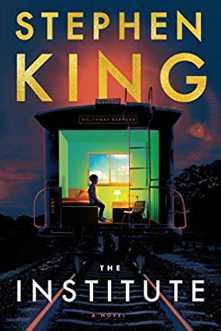
 There are only two authors in the world whose books I not only willingly, but enthusiastically, open even when they're 500 pages or more. One is J.K. Rowling (long live Harry Potter) and the other is Stephen King. That's because with either author I've never, ever been sorry that I did - and I'm delighted to report that the winning streak continues with this one.
At the outset, though, I had some doubts. Oh, not about the quality of writing - that's never gonna happen with this author. But the subject matter - the kidnapping and psychological and physical torture of children - just isn't something I wanted to read about for that many pages (one or two would be more than sufficient, thank you very much). But back to that amazing writing ability: Within a couple of chapters, I'd been hooked - and the reeling in continued to the very last page (which I stayed up way past my bedtime to reach, BTW).
The story opens with the kidnapping of the precocious young Luke Ellis and, almost as an aside, murder of his parents. He's drugged, and when he wakes up he's in a room that looks just like his room at home except it's not; he's in The Institute in remote Maine. Soon, he learns that he's not the only one here; he's surrounded by many other youngsters - all with a propensity for telekinesis and telepathy or both. And before long, he learns that the future is bleak; many other kids have been here, been put through the wringer and sent to another wing of the complex - never to be heard from again.
Meantime, readers get a glimpse into the new life of former cop Tim Jamieson, who finds himself - temporarily, he expects - in out-of-the-way Dupray, South Carolina. Though seriously overqualified, he applies for and lands a job as a "night knocker," a non-cop who walks through the very small downtown to make sure all the businesses and buildings are secure.
Most of the story focuses on the treatment, and mistreatment, of the youngsters at The Institute; all would like nothing better than to escape, but most are convinced that will never happen and some are even resigned to their fate. But as expected, their story and Tim's in the South Carolina setting come together at some point (no, I won't reveal when, how or why, but I will say the journey is filled with excitement, suspense and not a few rather gory details that kept me on the edge of my seat pretty much all the way through). It's not a perfect ending, but then I'm old enough to know that it's not a perfect world. It did, however, brighten the days I spent reading it. Well done!
The Institute by Stephen King (Scribner, September 2019); 576 pp.
4 stars out of 5
I admit to being more than a tiny bit claustrophobic
(go down in a submarine, even when it's docked? Fuhgettaboutit). But oddly, elevators really don't bother me too much. No, I'm not fond of them - especially those that are old, rickety and not much bigger than a bread box. But overall, I'm good.
This book changed that - albeit not as much as I'd expected based on the description. Most of the ups and downs happen near the beginning and end, with the middle more focused on the hows, whys and whodunits. And that's okay with me; it's still a fast-paced and thrilling book that "forced" me to stay up late to finish.
As the title suggests, elevators take center stage here, starting with an horrific and unexplained freefall in a midtown New York City highrise that leaves the occupants quite dead. Meanwhile, Detective Jerry Bourque and his partner Lois Delgado are called to the scene of a murder; the badly beaten victim is unidentifiable because whoever did him in chopped off all his fingers. Early on, readers also learn that Bourque is carrying around emotional baggage, some of which, at least, may be responsible for the bouts of severe shortness of breath that require him to carry an inhaler (making me wonder how that might be worked into the story as it progressed).
Throw into the mix journalist Barbara Matheson, who's got baggage of her own but has carved a successful career for herself at the expense of alienating the affections of a now-grown daughter. Most recently, she's been dogging the for-the-most-part unpopular New York mayor, a Trump-like guy whose nastiness is tempered only once in a while by a hint of compassion for other people (none of which is bestowed on his son Glover, who works for him).
There are questions of whether the murder and elevator plunge are related (acts of terrorism, perhaps?), but for the most part, city officials are trying to play down both incidents. Then the unthinkable happens: Another elevator misbehaves, this time mutilating one of the occupants whose identity triggers even more suspicions as to who's running the show. At this point, there's no choice but for the powers-that-be to come clean publicly, putting fear in the hearts of city residents who can't help but wonder if their building's elevator will be next and prompting city leaders - including the mayor - to fear that their actions (or inactions) could lead to even worse consequences.
Matters get even more complicated when Barbara's mom-defying daughter lands a job in the mayor's office and gets friendly with the mayor's son. Needless to say, mom's not a happy camper, but she seems up about far more than the potential for conflict of interest. As the investigation progresses, readers learn more about the characters and their backstories and read on in anticipation that one or more of them just might bite the dust on the elevator floor before the police get the drop on whoever's pushing the wrong buttons.
A very entertaining book on its own, but I must add - should no one else think of such a thing - it would make an excellent disaster movie as well.
Elevator Pitch by Linwood Barclay (William Morrow, September 2019); 464 pp.
5 stars out of 5
It's no secret that I love Bureau of Criminal
Apprehension agent Virgil Flowers - he long ago earned a forever spot on my Top 10 list of favorite book heroes. But it's also no secret that I'm not thrilled that he's in a serious relationship with a woman - Frankie - who in fact is close to delivering a set of twins she and Virgil concocted seven months or so ago. Somehow, he'd turned into a kinder and mellower Virgil - and in the process lost a bit of the edge that endeared him to me.
Well, after reading this, the 12th book in the series, I'd say he's still a little mellow and his language is, for the most part, more like a tricycle salesman than a truck driver. But overall, he's got that edge back - and for sure he's kept that irreverent sense of humor alive and well, as evidenced by my chuckles throughout, to-wit:
"You know how to kill any earworm? You hum that Walt Disney thing, 'It's a Small World.' It'll kill anything, but it's such a miserable song...it won't stay in your head on its own."
Couldn't have said it better myself.
But I digress. This story begins as Virgil is called in when a big-shot medical doctor and University of Minnesota professor is murdered in an upper-level, usually locked library room on the campus - a place he's really not supposed to be. Especially since he's for the most part an unlikable jerk, there's no shortage of suspects, from his research team colleagues to members of a rival research team to his own daughter. Most of the characters are quirky, to say the least (well, this is a university campus, after all). And early on, it appears the good doctor just might be living a secret life that involves illicit drugs and blackmail.
As is customary in these books, Virgil touches base with his former boss, Lucas Davenport (the subject of another popular series by this author and another of my love-to-read-about characters, BTW). A couple of his old friends get to help out, as does a scrappy female officer from the local police who gives Virgil a good run for his money in the sarcasm department.
Problem is, all of those above-mentioned suspects have what appear to be iron-clad alibis. Clearly, it will take a goodly amount of sleuthing to uncover the motive and catch the killer. All that is accomplished in fine Virgil style, making this another must-read book for fans like me. Thanks to the publisher, via NetGalley, for the opportunity to read and review an advance copy. Bloody good!
Bloody Genius by John Sandford (G.P. Putnam's Sons, October 2019); 384 pp.
 I'm a fan of this series and of Timber Creek Deputy Mattie Cobb and her K-9 partner Robo. While I enjoyed this one, the fifth, I have to say not quite as much as the predecessors. That is, I think, because of heavier focus on Mattie's romantic life and all the baggage she brings into her budding relationship with local veterinarian Cole Walker - I prefer reading about her relationship with Robo. As for Cole, I do have to wonder when he actually practices his trade given that he's always helping Mattie and her department, taking care of his two daughters and/or trying to cope with his ex-wife, Olivia, who suffers from serious depression.