Search This Blog

Showing posts with label medical. Show all posts

Monday, December 8, 2025

SPASM

4 stars out of 5

I love medical mysteries and thrillers, so it’s no surprise that this author has been a favorite for a long time – ever since his 1977 best-seller, Coma, in fact. I’ve read two others in the series featuring forensic pathologists Drs. Jack Stapleton and his wife, Laurie Montgomery (this is the 15th) and looked forward to reading another. It was enjoyable, yes, but it’s by far my least favorite of those I’ve read. My sentiments exactly? At one point, Jack expressed them for me by calling himself “stupid but lucky.”

The plot for the most part was intriguing, though wading through endless descriptions of the surroundings and what people were doing and wearing that were unrelated to the story made it drag a bit for me. Essentially, a group of white extremists known as the Diehard Patriots live in a renovated mansion in remote Essex Falls, New York – normally minding their own business except for late-night artillery exercises. Now, it seems they’ve brought in arms “experts” from another country to teach the scraggly group the art of the battle. Inexplicably, the “instructors” have set up a brewery in an outbuilding, but since the local community pretty much leaves the Patriots to themselves, no one seems to question why.

Recent events – specifically, the bizarre deaths of two of the Patriots – has caught the attention of local doctor Robert Neilson. And since he happens to be an old school friend, he calls Jack and asks for help. Besides those two deaths, the small community has been plagued by deaths as a result of early-onset dementia that progresses at an alarming rate. Conveniently, Jack and Laurie feel the need of a break from their busy routine at the Office of the Chief Medical Examiner in New York City, where Laurie is the chief ME, so they head upstate to Essex Falls. There, they fawn over the property, scenery and opportunities for Jack to practicing his beloved cycling (and trying to figure out where to stash it when he’s out in public so it won’t get stolen). Amid all this, he finds time to wonder what’s up with the increasing number of dementia patients. Other sleuthing around, mostly while Laurie is off with friends, leads to the possibility that all is not as it seems with the Patriots’ visitors and that what’s being concocted in that brewery may be some kind of bioweapon that threatens lives not just in this little backwoods community, but the entire country.

More details, of course, would spoil the adventure for others, so I’ll stop right here. Overall, it’s an intriguing tale, and I thank the publisher, via NetGalley, for providing me with the opportunity to get in on the action by way of a pre-release copy.

Spasm by Robin Cook (G.P. Putnam’s Sons, December 2025); 352 pp.

Friday, November 29, 2024

BELLEVUE

3.5 stars out of 5

Overall, I enjoyed this book - at least the premise of it. Abandoned former hospitals are not uncommon in many communities these days - there's one not far from my house - and there's nothing gets the old heart rate skyrocketing than the thought of a few unhinged ghosts wandering around in them. 

In this instance, it's the old Bellevue Psychiatric Hospital in New York City - long since closed but not torn down - still standing next to the current Bellevue Hospital. As a teaching facility, new classes of residents are admitted each year, and this season's group includes twenty-something Michael Fuller - known as Mitt. He's a bit surprised to have been selected for the residency, although he's aware that family ties might have played a role; several of his ancestors were noted physicians who practiced at the old Bellevue over the years dating back to its beginnings. 

In addition to his medical skills, Mitt has another one that he doesn't acknowledge publicly: precognitive ability (a.k.a., sixth sense). As he begins to work with patients under the supervision of seasoned physicians, it starts to kick in - but not in a good way. To begin with, he "sees" a young girl wearing a bloody dress and hears screams from people who aren't there. Then, during the surgery he's assisting with for his first "assignment," a couple of strange things happen. But that's not the worst part; inexplicably, the patient dies. 

Although what happened creeps Mitt out a bit, he chalks it up to happenstance. When the second of Mitt's assigned patients dies under unusual circumstances, though, it's a bit harder to shove under his mental rug. After the third, well, he starts to wonder if he's somehow responsible. That, in turn, makes him wonder what awful things really happened at that long-closed psych hospital - and what part his ancestors played in the horrific goings-on.

All that leads to an ending that, all things considered, wasn't too surprising. And while it held my attention throughout, in the end, it was repetition - and to a certain extent, predictability - that kept me from loving this book (as is my custom for books by this author). Still, I enjoyed it very much and thank the publisher, via NetGalley, for the opportunity to read and review a pre-release copy.

Bellevue by Robin Cook (G.P. Putnam's Sons, December 2024); 351 pp.

Thursday, November 10, 2022

NIGHT SHIFT

4 stars out of 5

Medical (and legal) are my favorite sub-thriller genres, and I'm always delighted to see a medically-focused book from this author. For the most part, this one did not disappoint. Smack dab in the middle of the action are husband-and-wife medical examiners Jack Stapleton and Laurie Montgomery (well, she's now the chief ME for the city of New York, technically Jack's boss and a bone of contention between the two, as is the fact that he refuses to give up riding his bicycle to and from the ME's office). The two share a couple of young kids, both with medical issues; they're cared for by Laurie's mother, who's exceptionally competent despite being an anti-vaxxer (her odd-woman-out status and the mask or not to mask issue is interspersed throughout the story).

Early on, another physician, Sue Passero, is found dead in Laurie's hospital parking garage; an autopsy is a must, and because Sue was a good friend, Laurie asks Jack to handle it. Sue's diabetes ups the odds that her death was a heart attack, but the autopsy shows that clearly wasn't the case. Suicide? A not-likely possibility. The other option? Murder - but with an autopsy that turns up no means or motive (and, of course, no whodunit).

Perplexed - an emotion he does not enjoy experiencing - Jack sets off to determine Sue's cause of death; after all, he needs to sign a death certificate, the sooner the better, or so Laurie insists. So, he circumvents a few of the rules instituted by the hospital (now owned, it is noted several times, by a big bad conglomerate known for putting profits above professionalism) and meets with a few of Sue's admirers and a few who are not. What he learns from one on the friends side - and what happens next - is even more perplexing and worrisome, making Jack even more intent on getting to what may be a deadly truth in ways guaranteed not to please him or his wife.

There's plenty of action, and of course, I love all the descriptions of medical procedures (also plentiful), but of course I can't get into more detail without giving away too much. The only thing confusing me a bit is that the book, which I received pre-release courtesy of the publisher via NetGalley - thanks very much - is why the description shows 432 pages when I downloaded it and only 240 on Amazon, where it's for sale. That's a big chunk to lose - gotta wonder what didn't make the cut! 

Night Shift by Robin Cook (G.P. Putnam's Sons, December 2022); 240 pp.

Sunday, December 19, 2021

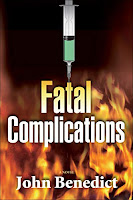
FATAL COMPLICATIONS

4 stars out of 5

Let me say this right up front: I can take a little, even more than a little, sappy romance; while it's more plentiful here than I'd like, it's tolerable. But getting gobsmacked by an obvious religious slant in a book that's described as a medical thriller made me want to throw my Kindle against the wall. My Spidey senses started to twitch when I learned that one main character almost didn't marry her husband because he wasn't the perfect God-fearing man she really wanted (he was otherwise acceptable, though, so she decided to chance it). My suspicions were right; the theme is dotted throughout the book all the way to the end.

Redemption (pun intended) comes in the last half or so of the book, which is packed with plenty of action on the medical front, reminiscent of my old favorite authors like Robin Cook and Michael Crichton. I loved the lengthy, explicitly detailed descriptions of medical live-or-die procedures - some of which went one way, some another. The ending defies reality (make that outright destroys it), but it was edge-of-seat exciting nonetheless. 

Anesthesiologist Luke Daulton is relatively new on the job at Swatara Regional Hospital near Hershey, Pennsylvania (where I've screamed on the rides at Hersheypark and, of course, consumed way too much of that delicious chocolate). Assisting with a surgery that takes a deadly turn, Luke begins to question not only what went wrong and why, but who - and whether there's some kind of conspiracy afoot. He's got a doctor friend who is in the midst of a love crisis between his wife and drop-dead-gorgeous girlfriend as well as a wife who's close to delivering their firstborn. On that last point, given still too-high rates of unnecessary C-sections in this country it was disappointing that the soon-to-be-mom insisted on a C-section not for medical reasons, but because she can't fathom enduring that much pain and her obstetrician agreed. But then again, that's just me. 

Readers are privileged to get the inside scoop along the way, starting with a portent of things to come in the first few pages. Tension is heightened by watching characters concoct theories and make misjudgments that can (and do) cost them their lives - prompting us to concoct theories and make misjudgments of our own. The pace turns absolutely frantic as the end nears, bringing with it one red hot surprise. The bottom line? If you love medical-tinged drama and don't mind some religious overtones, this certainly isn't a bad choice. That said, it's probably not one you'll want to stash in your purse to read in the doctor's waiting room.

Fatal Complications by John Benedict (Oceanview Publishing, 2015; paperback release, 2021); 290 pp.

Monday, April 26, 2021

THE BONE CODE

4 stars out of 5

I've been a fan of this series it seems like forever - this is the 20th book, and I doubt I've missed more than a couple. They're always a treat to read, and this one is no exception. Forensic anthropologist Temperance Brennan is off to meet a friend who lives on the Isle of Palms off the coast of South Carolina amid a Category 3 storm that's threatening evacuation. A call from the coroner in Charleston tells her some kind of container has washed up on the beach. It seems the container's filled with two dead bodies - wrapped up in plastic sheeting and secured with electrical wire. Uh, oh, Tempe says to herself - that's too close for comfort to a case she handled in Quebec, where she regularly serves as a consultant in Montreal.

Concerned, she snags a flight to Montreal, hoping she can convince her supervisor there to reopen that old case. But she's also eager to touch base with her love buddy, Andrew Ryan, who's retired from the police and now puts his investigative skills to work as a private eye.

Just as she's prepping to head out, though, she's visited by an elderly lady  who shows Tempe some photos and asks for help identifying a suspected ancestor. A little bit of research unearths a connection to so-called "death masks," but Tempe has little time to deal with it and hands off the task to the friend with whom she's staying on the island (there's a bit more mention of this story thread and it's kind of interesting, but it never seemed very important to the rest of the book).

As if dead bodies and a potentially deadly hurricane weren't enough, Charleston is facing terror of a different sort: not long after the threat of COVID-19 has faded, a new virus is on the horizon and spreading quickly. Tagged as "capnocytophaga," it appears to be transmitted to humans by way of dog bites. This outbreak, too, threads its way throughout the story, but the really good part lies in whether, and how, there's a connection between the four bodies found in containers 15 years apart. That investigation, with Tempe's charge aided and abetted by Andrew, gets the lion's share of pages (as it should) and puts both of their lives in danger more than once.

Throughout it all, the author's humor shines through (sometimes in the form of banter between Tempe and Andrew). And oh, did I mention how much I love Andrew? Not only is he extremely competent and oozes French charm when he wants to, this guy drinks Moosehead. That makes him un homme apres mon propre coeur (a man after my own heart, if my Googled translation is correct).

I must say, though, that while I love the medical stuff - one of the main reasons I'm attracted to this series - this one was a little too technical in spots for me to fully "get." But hear this: at no point did I want to put it down. In large part, chalk that up to the author's game of ending chapters with cliffhangers (some more precarious than others). Yeah, I tried to ignore that when dinner or bedtime came, but more often than not, she won.

All in all, excellent once again. Many thanks to the publisher, via NetGalley, for allowing me to read and review a pre-release copy.

The Bone Code by Kathy Reichs (Scribner, July 2021); 368 pp.

Sunday, August 7, 2016

BRAIN STORM

4 stars out of 5


One thing's for sure: The title couldn't be any more perfect. And although I'm a bit less enthusiastic about the rest of the book, it's a solid launch for what I expect to be a series. I'm a huge fan of medically induced dramas (characters like Patricia Cornwell's Kay Scarpetta, Tess Gerritsen's Maura Isles and yes, even James Patterson's Claire Washburn (she of the Women's Murder Club series) are among my favorites), and this one introduced me to a whole new profession: Death investigator. It is mostly for that reason - and the potential for an excellent series - that rounding up my actual 3.5-star rating to 4 was a no-brainer (half-stars aren't possible at most review websites).

Such is the job of lead character Angela Richman, who is felled by a series of six strokes and saved by the expertise of egomaniacal neurosurgeon Jeb Travis Tritt after being misdiagnosed by another full-of-himself doctor who practices at the same hospital. Interestingly, the author herself had a similar experience, much of which she no doubt used to shape this story.

But as Angela struggles to regain her investigative skills amid medical setbacks and hospital screw-ups, another drama emerges: Despite his obvious talent, no one at the hospital or in the community wants the neurosurgeon (who yes, was named after the country singer) around. He's not, you see, cut from the same cloth as the locals in the very close-knit community called the Forest. Not so for the  doctor who misdiagnosed Angela in the first place; his smooth talking manner - and more to the point, his family's heritage and money - make him a local hero whose image is untarnishable.

That the two doctors share a bitter dislike of each other is pretty much a given; so when the popular doc gets bumped off, it's no surprise that the "outsider" becomes the prime suspect. Angela, though, has serious doubts about his guilt (despite his late-night rants in her hospital room about the other doctor's ineptitude), but her mind is so much in turmoil as she recovers from her own brain surgery that it's hard for her to discern what's real and what's not. She gets help from her friend Katie, a doctor/medical examiner who's overly fond not only of salty language but of reminding everyone that the people who land on her table can't talk, sing, swim (fill in the blank). Okay, my dear, we got it the first time - they're dead. Now give it a rest. 

In the midst of all this, Katie is trying to round up loose ends on a case of her own; someone at the hospital, it seems, is a serial "Angel of Death," killing patients who otherwise should have survived (ah - could that be tied to the murder of Angela's neurosurgeon)? As Angela moves toward recovery of her former well-honed investigative skills, she unearths clues that lead to the answer of that question as well as the murderer's identity and illicit goings-on in the hospital.

The story doesn't end there, though; an epilogue describes how all the characters ended up after the major brouhaha has passed. That's a nice touch, actually, and I'm left with only one question: When Angela left the hospital, she was taking the blood-thinner Warfarin. But just a few days later, it's mentioned that she's on Coumadin (another brand-name blood thinner). Huh?

All in all, this is a great read-on-the-beach kind of book and I thank the author and publisher, via NetGalley, for a copy in exchange for an honest review. When the death investigator makes her next appearance, I hope I'll be on the list to read it as well.

Brain Storm by Elaine Viets (Thomas & Mercer, August 2016); 322 pp.

Wednesday, January 27, 2016

THE TUMOR

5 stars out of 5

This short "book" (67 pages) puts the spotlight on focused ultrasound, a medical treatment procedure involving "intersecting beams of high-frequency sound concentrated accurately and precisely on tissue deep in the body..." The noninvasive procedure is in various stages of development for healing more than 50 diseases and conditions such as Parkinson's and tumors of the brain, liver, pancreas and lung.

The goal, no doubt, is to ramp up awareness of the technology and the need to speed up the approval process for more applications and financial contributions toward the cause. In the interests of full disclosure, Grisham's friend and neighbor Neal Kassell, M.D., a neurosurgeon and proponent, founded the Focused Ultrasound Foundation (based in Charlottesville, Virginia), and Grisham is on the Board of Directors. It's equally important to note that the book is free for downloading at various websites including Amazon
(http://www.amazon.com/The-Tumor-A-Non-Legal-Thriller-ebook/dp/B01AUYDNI6).

Incorporating narrative and graphics, Grisham outlines the benefits of the technology and how it has the potential to improve both quality and length of life for cancer patients who qualify for treatment. More information, including a link to a video of Grisham's TEDx presentation, can be found at the Foundation's website (links are provided in the book).

Grisham calls this the most important book he has ever written. I call it highly informative and more than worth the brief time it takes to read it. 

The Tumor: A Non-Legal Thriller by John Grisham (Focused Ultrasound Foundation, January 2016); 67 pages.

Sunday, June 7, 2015

EVERY FIFTEEN MINUTES

3 stars out of 5

I've read and enjoyed a handful of books by Lisa Scottoline, but none in the last couple of years. When I saw that this one has a medical slant - and even more special to me, psychiatry - I just couldn't pass it up. But alas, it fell a bit short of my expectations; when it came time to rate it, I waffled back and forth between 3.5 and 4 stars, finally settling on the lower number because while it was very readable, there were just too many things that kept it from being great.

Before I decided to tackle this one, I did what I always do: Check reviews from other readers. One of the biggest complaints is that there's too much exposition regarding the workings of psychiatric care; while I tend to agree somewhat, it really didn't bother me much because - although I didn't learn much I didn't already know - I have a strong interest in the field. Rather, my biggest concerns are that the central character Dr. Erick Parrish, a highly regarded chief of the Psychiatric Unit of a hospital near Philadelphia and father (with an ex-wife) of a 7-year-old daughter, turned out to be an annoyingly obsessive person who, given his profession, should know better. As a father, his emotions are overwrought and over the top, but understandable; as a practicing psychiatrist, they cross the line into the realm of ridiculous a few too many times. 

Interspersed throughout are chapters written from the perspective of a sociopath - one who, I assumed, is out to bring Eric down. But who is it, and will the police (and/or Eric) discover the identity before it's too late? I read those chapters with great interest, looking for clues but found none; at best, those chapters simply outlined manifestations of sociopathic behavior, making me wonder why they were there at all.

As the story unfolds, Eric meets 17-year old Max, who's got a druggie mother and a grandmother he adores; so when she dies, he's devastated. He's also got an OCD personality, needing to tap his head and recite a few words every 15 minutes on the dot (in a Gestalt "Aha," the apparent source of the book's title). The good doctor is concerned about the young man's mental well-being and takes him on as a private patient, seeing him at home. But when Max's supposed girlfriend is murdered, he goes missing. Could Eric have missed the signs that Max is capable of murder? Ever more concerned, Eric tries to find the boy and ends up a suspect himself.

I also got a bit weary of all the issues that plagued Eric - from custody battles over his daughter to his house being torn upside down by police carrying out a search warrant . Often, I thought of Michael Corleone's line from "The Godfather": "Just when I thought I was out...they pull me back in." Just when you think things can't get any worse here, the temperature of the hot water Erick is in already climbs higher. Combined  with his obsessive personality, by the time that water reached the boiling point, I said enough, already - I don't much care much whether it cools off or not.

If you enjoy medical thrillers, this really isn't a bad choice; I'll simply say that it's not Scottoline at her best.

Every Fifteen Minutes by Lisa Scottoline (St Martin's Press, April 2015); 446 pp.

Sunday, May 31, 2015

CODE BLUE

3 stars out of 5

If a mystery/thriller has a medical or legal focus, it'll get my attention. If it's part of a series, even better; I love to have something on the back burner to turn to when my supply of favorite-author books starts to dwindle. I had high hopes for this book about the trials and tribulations of Dr. Cathy Sewell, who returns to her home town to set up her own practice. It's the first of three books in the "Prescription for Trouble" series by the author, a retired physician.

What I didn't realize is that the book might be more accurately listed under Christian fiction. Certainly I should have known; it's published by Abington Press, an imprint of The United Methodist Publishing House. But even though that's not my style (not even close, in fact), I must say I wasn't overwhelmed with the "I hate God for allowing my parents to die" followed by a lecture on why that's not true kind of thing. Only in a couple of places did talk of converting to true believer status become intrusive, and I was able to speed-read my way through those and get on with the story.

Cathy, it seems, returned home after ending a bad relationship - still grieving at the untimely loss of her parents in an accident just as she finished medical school. But sometimes it just doesn't pay to go home again; early on, it appears someone wants her to turn tail and get outta Dodge. Or maybe it's several someones; she has trouble getting a loan to set up her practice, trouble getting privileges at the local hospital, trouble driving down the road without being attacked by a mysterious black SUV and trouble when patients she treats end up in worse condition than when they came to see her. Given all that plus her past life experiences, she's lost the ability to trust - not even a local (and hunky) lawyer who promises to take care of her - and certainly not her own judgment.

All things considered, it really wasn't a bad story. I'll emphasize that the religious slant isn't the reason for my mid-point rating, nor is the technical quality of writing. In fact, it was nice to read a book that doesn't have grammar, punctuation and spelling errors splattered throughout every other chapter. Rather, it's because the overall plot is a little simplistic, and some of the details - which I can't mention without issuing a spoiler alert - just didn't have real-life plausibility. What happens to Cathy borders on overkill, so to speak; you think you're having a bad day? After reading only a few chapters that detail what she's going through, your life will seem like a walk in the park. 

Still, at just 288 pages, it's a quick, easy read - ideal for my "fill-in" series requirement. And while it's far from the best book I ever read, it was good enough that I'm not calling in the crash cart for this series; in fact, I'm likely to try the next two, Medical Error and Diagnosis Death. I'll keep you posted!

Code Blue by Richard L. Mabry, M.D. (Abingdon Press, April 2010); 288 pp.)

Monday, March 23, 2015

EMBRYO

4 stars out of 5 


I'm a huge fan of medical thrillers - even more than legal and police procedurals, which I love. When Robin Cook, Tess Gerritsen, Patricia Cornwell and Kathy Reichs come out with new books, I'm chomping at the bit to get my eyes on them. This one was offered free on BookBub last April, and after reading the description I decided to take a chance despite a few less-than-glowing reviews (actually, the number of 5-star ratings far outweighed the 1-stars - 402 to 14 at the time of this writing, and the latter seemed to me to be so unusually nasty that I gave them short shrift).

Besides, I reasoned, the book is only 238 pages - an easy three-day read even if I don't have a lot of extra time. So, I added it to my collection - and there it sat until now, when I was in the mood for something I could finish rather quickly while I gathered up momentum to start something lengthier. I'd give it half a dozen chapters, I told myself, and if it didn't grab me by then, I'd fold up my tent and go elsewhere. But by golly, that tent never got unfolded; by the time I reached the 25% mark, I was caught up enough in the action that there was no question of stopping. 

The book is the first in a series about intern Jill Raney and her resident supervisor, David Levine; early on, she discovers strange goings-on at "her" hospital, a prominent fertility and genetic engineering facility. Two pregnant women unexpectedly die and a seriously malformed fetus is delivered. Then, another pregnant woman turns up dead - this one clearly murdered, and her body has been drained of amniotic fluid. By now, Jill is nearly frantic, but hospital officials deny that anything is amiss and maintain that the deaths are in no way connected.

Needless to say, Jill refuses to quit until she proves her point (along the way convincing David - now her lover - that she isn't hallucinating). The pace picks up steam as Jill collects the evidence she needs; but can she come up with sufficient proof before more people are killed - herself included?

I really enjoyed this book, but admittedly, I had a couple of issues. First, I was surprised that Jill wasn't given the boot way back when she began ranting about her findings, despite several warnings to back off from hospital officials. Yes, her darling David ran interference for her, but he's "only" a resident himself, so I can't imagine his word would carry more weight that of department heads. Also, Jill seems far more prone to overwrought emotions than I'd expect from someone who's survived the rigors of medical school and, as an intern, been there, seen that. To be sure, it's a treat to find medical professionals who have a heart behind their stethoscopes, but most I've seen are not knee-jerk reactionists (nor should they be).

The ending leads the main characters on a not-so-merry chase to catch or be killed, a chase that was exciting until I got to David's sudden rationale that "Doctors don't shoot doctors" (but killing them with bare hands instead is just dandy). When I got to that one, I actually laughed out loud. First, it isn't even logical; second, this is a matter of survival; if the only way out is to kill someone, I seriously doubt Hippocrates would give a rip what you had to use to get the job done.

All in all, the book is well written and kept me turning pages (well, okay, tapping a stylus on my Kindle Fire) far longer at a time than I intended each time I sat down to read. Next up in the series is Embryo 2: Crosshairs; I haven't decided whether I'll get it - too many other books in my want-to-read pile at the moment - but I'm keeping my options open because I'm pretty sure I won't be disappointed.

Embryo by J.A. Schneider (J.A. Schneider & R.G. Schneider, M.D., May 2012); 238 pp.

Tuesday, September 9, 2014

FINAL MERCY

4 stars out of 5

As a huge fan of medical mysteries, I jumped at the chance to read this free with my Kindle Unlimited trial subscription. And when I learned it takes place in the Finger Lakes region of New York -- one of my favorite places to visit -- I was even more excited.

I'm pretty sure, though, that neither the town of New Canterbury nor Stanwick Lake are real - there are 11 Finger Lakes, and Stanwick isn't among them (our usual stopping place is somewhere along Seneca Lake in the Watkins Glen area, where, to our great delight, there must be at least 30 wineries within a 10-mile radius). But it's the thought that counts - and this story is set mostly at the New Canterbury University Hospital, where Dr. Jack Forester is director of the emergency department and trying to bring it into the 20th century in terms of services and equipment.

The prologue, which I understand has been rewritten since the first edition was published (this is the second), was intriguing; but after I'd read the first couple of chapters, I was a little concerned; the writing seemed a bit simplistic. Oh well, I said, I'll keep going and see how it goes. And I'm happy to say it turned much better and stayed that way right to the end (which didn't take long since it's just 302 pages).

Early on, it's clear there's a leadership battle going on; the new dean, Bryson Witmer, is a dude with an ego the size of Texas who won't tolerate a no from anyone, runs roughshod over the medical staff and takes no prisoners. Needless to say, that doesn't please Forester; and things go from bad to worse when his mentor (the former dean) is the victim of an apparent murder attempt that follows close on the heels of the deaths of two other key hospital professionals. All three, it seems, were not fond of Witmer and his practices, and their disposal conveniently clears his path to even greater power.

Enter the beautiful Zellie Andersen, an investigative reporter who has come to town do an in-depth story on the hospital. But as her interviews pick up steam, it's clear she's getting very different perspectives from Witmer and Forester. So who's telling the truth? The answer comes amid conspiracy and yes, more murders.

There were a few glitches along the way -- a handful of grammatical errors and what was described as a half-mile walk to a hotel that turned out to take considerably longer by car, for instance -- and the ending (where the action really picks up), leaned a bit toward the "you've got to be kidding" side. That said, I enjoyed the book and am looking forward to the sequel. At the end of this one, the author says it will be titled "Bedside," but as of this writing I'm still looking. Hope it turns up soon!

Final Mercy by Frank L. Edwards (Pascal Editions, 2nd edition, February 2013); 302 pp.